Build the shared model
Align on the Mix reference point, Copilot Studio's current model, user needs, technical boundaries, and where “parity” concealed different assumptions.
I brought complex behavior-authoring experience from Nuance Mix.dialog into Copilot Studio, then moved into Microsoft CoreAI to help a 30+ person design organization explore, critique, and build AI products faster.
The acquisition, promotion, and transfer show a continuous expansion of responsibility—not a set of unrelated Microsoft projects.
My Microsoft tenure began through the Nuance acquisition while I continued working across Mix.dialog and the later Verse design-system chapter.
Joined the team designing conversational AI authoring experiences, bringing prior experience with deeply nested logic and behavior authoring from Nuance Mix.dialog.
Expanded from individual interaction work into cross-functional facilitation and product-direction framing, including a three-day stakeholder design sprint on the largest Mix-to-Copilot Studio parity opportunities.
Transferred into a hybrid design-engineering role supporting Microsoft Foundry and Azure portal teams through rapid prototyping, reusable agent skills, mini products, and AI workflow leadership.
CoreAI Computational Design & Research / Azure / VS Code / I like to make things
July 20, 2026, Alex worked with Erik on the same team
I worked alongside Erik as a peer, and he's genuinely one of those people who makes everyone around him better. As a User Experience Engineer, he's great at taking fuzzy, half-formed ideas and turning them into clear direction.
What stood out most was how he collaborated. Erik was a great partner to bounce ideas off of, especially in messy, undefined spaces where there's not much prior art to work from. He was genuinely good at spotting emerging trends and staying ahead of the curve on AI, then breaking things down so the rest of us could actually follow. We'd experiment together with these ideas, trying to figure out if we could use them to help our Azure team move faster and work more consistently.
He was also generous with his time, especially with the UX designers on the team. He worked closely with them and helped a lot of people build the confidence to start pushing their own PRs, which for many of them had felt like a pretty daunting jump. That kind of patient, empowering mentorship isn't common, and it raised the whole team up. Whether we were working through an ambiguous problem or aligning with other teams, he kept things constructive and honest, and he was always focused on the best outcome, not just his own.
I can't say enough good things about working with Erik. He's sharp, he's generous with what he knows, and any team would be lucky to have him. I'd work with him again in a heartbeat.
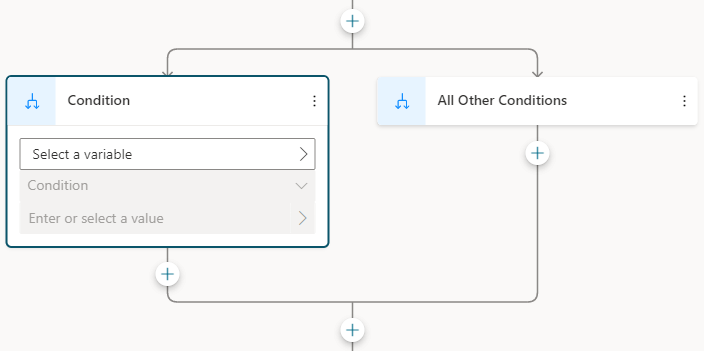
Copilot Studio needed stronger support for nested conditions. My Mix.dialog background gave the team a working reference for how enterprise authors build, read, and debug complex conversational logic.
Parity was not a checklist exercise. Nested conditions affect how authors scan branches, understand precedence, recover from errors, and trust what a conversational system will do at runtime.
I worked on nested-condition authoring for Copilot Studio with the goal of reaching the functional depth users had in Nuance Mix, while fitting Microsoft's product model and interaction patterns.
The transferable insight was not a screen. It was a model of where conditional complexity becomes hard to comprehend.
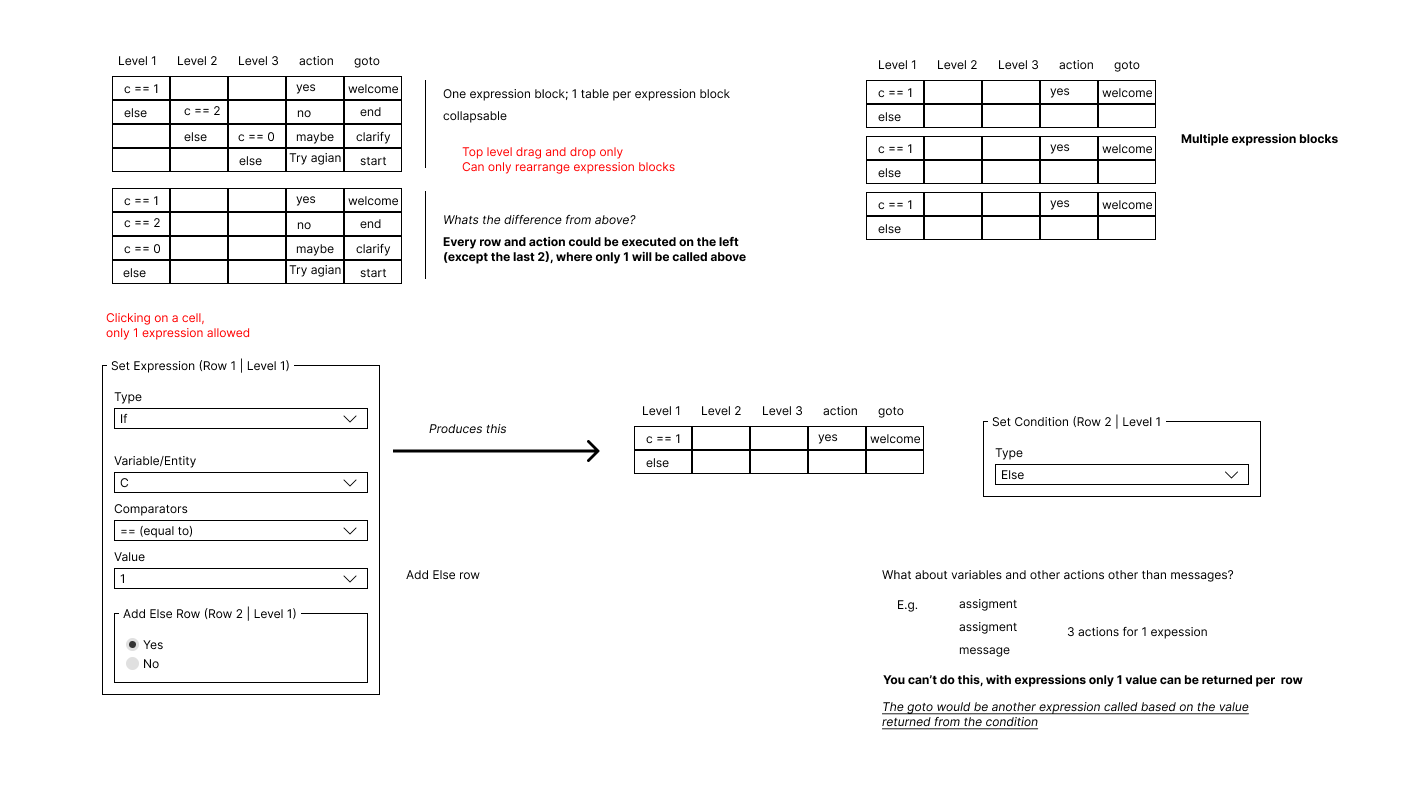
I planned and ran a three-day workshop to convert a broad parity goal into a shared view of the highest-value problems to pursue.
Align on the Mix reference point, Copilot Studio's current model, user needs, technical boundaries, and where “parity” concealed different assumptions.
Generate and compare approaches across authoring, comprehension, validation, and debugging instead of prematurely converging on one interface.
Prioritize the areas that could create the largest step change and leave stakeholders with a clearer product sequence for deeper exploration.
Production repositories were too costly and constrained for many early design questions. Static design tools could show a state, but not the behavior of an agentic system.
My transfer to CoreAI made that gap the center of my role: build smaller, safer environments where designers, PMs, and engineers could make the behavior real early enough to learn from it.
On Microsoft Foundry I designed and built tools that helped the team move from an idea to a testable interaction without waiting for the production repo.
The output was not one monolithic platform. It was a family of focused tools that reduced the cost of answering a design question.
A GUI prototyping environment where designers could use agents to create and modify working interface experiments, then iterate in a tighter visual loop.
Tools for marking up a running interface and converting feedback into clearer, actionable context for an agent or implementation partner.
Focused versions of Microsoft products that preserved the behavior needed for design evaluation while remaining much faster to change than production systems.
Robust instructions and context packages that helped Copilot and other agents apply the correct product conventions with less drift.
I helped apply these prototyping tools to early feature work for Azure SRE Agent. The concepts were still in development and I did not finish them during my involvement, so this work is presented as an application of the prototyping method—not as completed or shipped product work.
Some of the mini-app and agent-context work extended into Azure portal experiences. My contribution was primarily the shared prototyping infrastructure and team enablement—not product ownership for an individual Azure service.
With another technical designer, I built a robust miniature version of Azure that designers, PMs, and developers could use to rapidly prototype features. It gave the teams a common executable surface without requiring every idea to enter the production codebase.
I helped create stronger AI skills for Copilot and other agents, especially around the many product-specific implementations of Fluent 2 found across Azure portals.
An npm package that gave agents a semantic map of where to find the correct resource and how to interpret it, reducing confusion between similarly named design-system sources and product variants.
I paired implementation with teaching: weekly learning sessions, hands-on guidance, and patterns the design team could reuse without waiting for a specialist.
Helped designers build with LLMs and agents directly, moving AI from a specialist tool into the team's everyday prototyping practice.
Made interactions executable earlier, so product, design, and engineering could react to behavior rather than infer it from static screens.
Improved the context agents received about components, product variants, and source authority—reducing plausible but incorrect implementation choices.
AI Designer @ Microsoft CoreAI
July 11, 2026, Xiaowei worked with Erik on the same team
Working with Erik has been such a pleasure, and he's one of the most talented UX engineers I know. He's been a driving force behind the agentic tooling our team relies on. He's a big contributor to Li'l Azure, an agentic playground that turns ideas into working Azure experiences in real code, and he built Ledger, a clever workflow that turns markdown rules into deterministic scripts. Both have genuinely shaped my own agentic prototyping journey and helped the whole team move faster from design intent to working code. That kind of forward-looking, design-to-code thinking is exactly where our craft is heading.
I also really appreciated Erik's help on the SRE Agent. His ideas were thoughtful and full of fresh inspiration, and because he builds working prototypes instead of static mockups, they were easy for everyone to rally around. On top of all that, Erik is curious, generous with what he learns, and genuinely kind to work with. Any team would be lucky to have him.
Official implementations lived in Microsoft's managed environment and are described here at a high level. Public links establish product context; selected sandbox work demonstrates methods, not shipped Microsoft code.
Public context for Microsoft's agent and workflow authoring product.
Visit the productThe AI app and agent platform Erik prototypes across, formerly Azure AI Foundry.
Visit the productPublic context for the reliability product where Erik applied the prototyping toolkit to unfinished feature explorations.
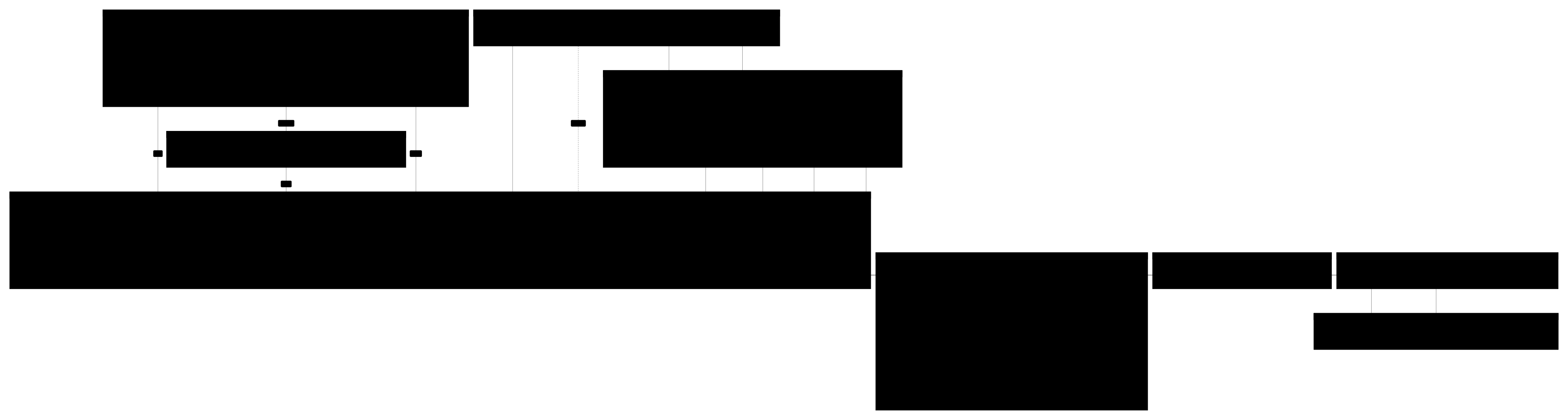
Visit the productA sanitized diagram from a personal-account experiment showing spec-driven design QA and visual feedback methods for AI agents. It demonstrates method, not official Microsoft implementation.